How the Spin-off Rheoo is bringing a new recipe to the manufacturing process for optical coatings and filters. Rheoo enables digitally controlled creation of optical coatings and filters, resulting in virtually waste-free, energy-efficient, fast and highly flexible manufacturing.
Optical coatings are invisible in everyday life, yet they are everywhere: on eyeglass lenses, displays or camera lenses. They prevent reflections, let certain wavelengths pass or block them through a filter effect. Technically speaking, they consist of many artificial glass and/or polymer layers stacked on top of each other – each layer is about 1/1000th the diameter of a human hair, i.e., nanometer range. Founder Qiaoshuang Zhang illustrates: “The layer structure can be compared to a stack of pancakes. Only instead of flour, eggs and milk, it consists of many layers of transparent optical materials, each about 100 nanometers thick.” Until now these multilayer stacks have been produced in prolonged vacuum processes. First the chamber is evacuated, then the product can be coated layer by layer in a complex vapor deposition process. “The process takes several hours to days, the coating dimension is limited to the size of the chamber and materials such as plastics can contaminate the equipment,” Zhang explains. The process is not very flexible and working under vacuum conditions is also energy-intensive and expensive. Mass production therefore quickly hits its limits. Scaling requires an entire factory floor full of vacuum chambers – hardly an ideal scaling solution. The Karlsruhe-based spin-off Rheoo has however found a new “recipe”. Instead of preparing the pancake stacks in a vacuum, they print the layers using an inkjet printer.
From the PhD to Rheoo
The idea originated during Zhang’s doctoral work at the Light Technology Institute (LTI) at KIT, where she worked on micro- and nanofabrication for optical elements. Initial research results and the enthusiastic response at industry trade fairs sparked curiosity – and not just for her. “We quickly realized that there was huge demand for an efficient solution,” recalls Zhang. Together with her colleague Qihao Jin, she decided to turn the research successes into practice. With support from the EXIST Research Transfer, they founded Rheoo in 2024 and have since set up a small, automated production line equipped with printing hardware.
How Rheoo works
Optical coatings are everywhere – on eyeglass lenses, displays, sensors etc. However, their production is energyintensive, expensive and inflexible. To make production more innovative, the spin-off Rheoo has developed a vacuum-free inkjet printing process. This enables digitally controlled creation of optical coatings and filters, resulting in virtually waste-free, energy-efficient, fast and highly flexible manufacturing.
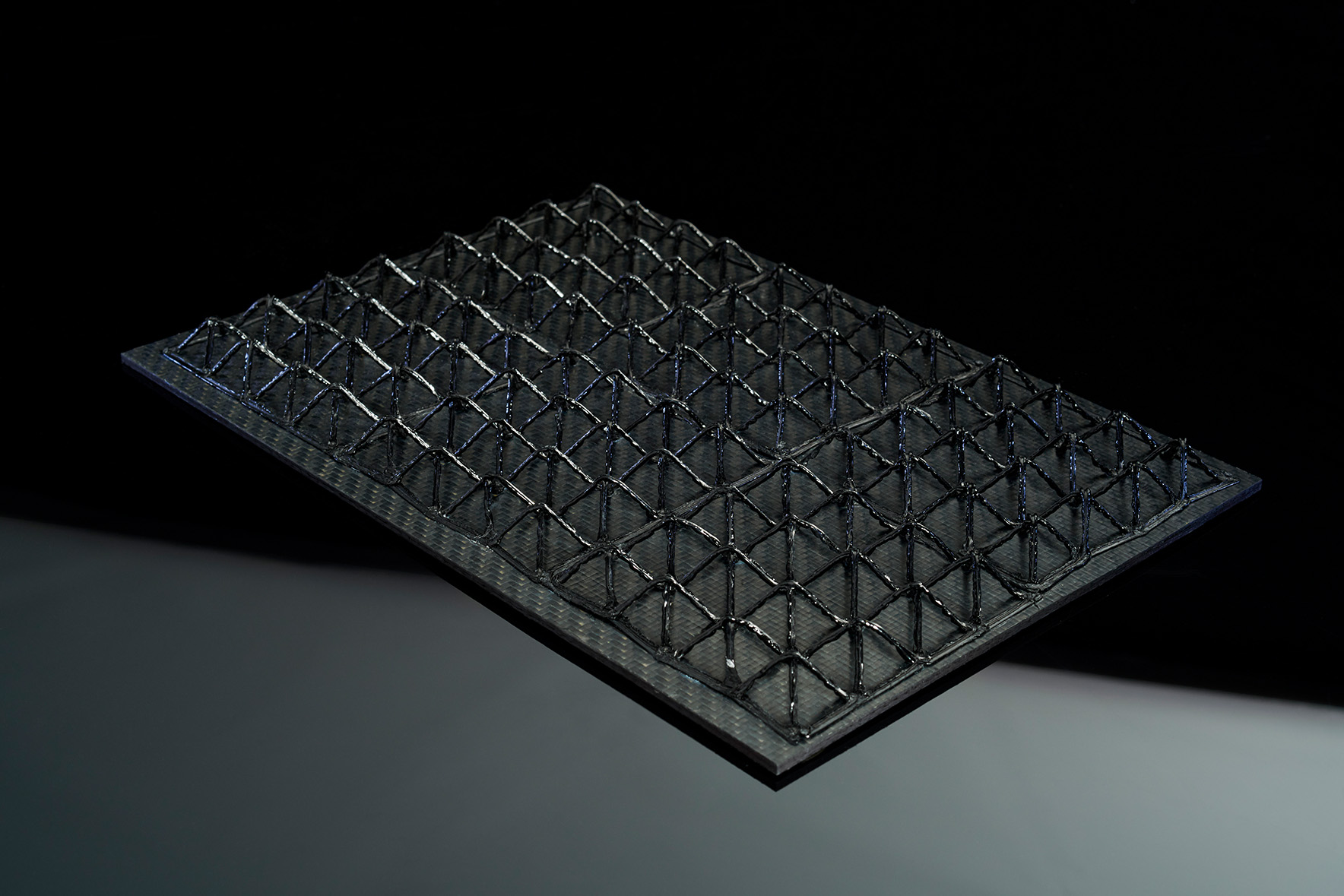
Rheoo´s inkjet process enables precise optical coatings without a vacuum chamber - printed layer by layer instead of a vapor-deposited.
From Vacuum to Inkjet Printing
Rheoo´s inkjet process allows digital patterns to be scanned in and coated with pinpoint accuracy only where they are actually needed. “We can coat specific areas, structure them flexibly and even work directly on plastic or sensors – in other words, on substrates that would not be compatible with vacuum processes,” explains Zhang. The big advantage: Inkjet printing has long been established as a proven, high-precision technology – used for OLED displays, solar cells and printed electronics. It can be integrated into existing production lines without having to rebuild entire production environments, giving industry new degrees of freedom: faster cycles, flexible surfaces, precise structures and all with significantly lower energy and cost consumption. Zhang sums it up: “Targeted, locally limited printing means there is no unnecessary waste and the process takes minutes instead of hours. In addition, our process requires significantly less energy because we do not rely on vacuum.” Compared to previous processes, this seems like a small but decisive lever – nanometer work with a big effect.
From Lab Test to Production Line
The founding team has already proven that the technology works. The current challenge is to transfer the technology from the laboratory to industrial scale. The team including third Co-founder Jan Fischer presently aims to refine Rheoo’s automated production line, in which robots shuttle samples between the printer and post processing stations. “We are currently working on an intermediate step between research and fully automated mass production,” explains Fischer. “This is a challenge because all the equipment has to work together perfectly. Our goal is to achieve reproducible quality, make it measurable and continuously improve the processes.”
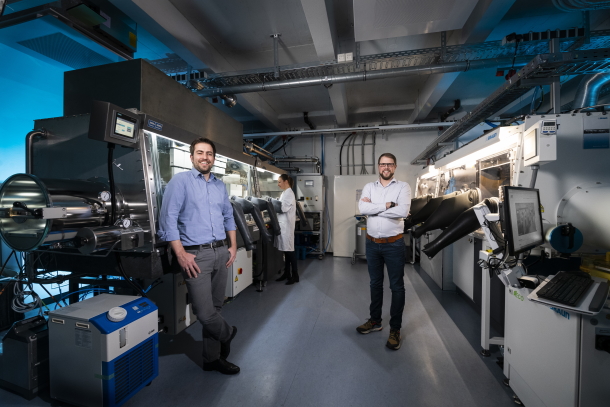
Precision work in the nanometer range: in the laboratory, the Rheoo team tests new material formulations and printing processes for reproducible coating results.
From Pilot Project to Market
Simultaneously, the team is conducting applicationspecific feasibility studies with pilot customers from various industries. Although the focus is still on tests and prototypes, the objective is clear: move from feasibility to market launch. “We are in intensive discussions with our partners to determine what the next step will be and how we can achieve a successful market entry,” Zhang says. Potential applications range from simple anti-reflective coatings for displays and cameras to complex multi-layer systems for sensor technology, medical devices and communication technology. “There are very simple coatings with only one layer, like a single pancake, but also very complicated variants with many layers, like a whole stack of pancakes,” says Zhang, describing the range. The team is deliberately starting with simple coatings for anti-reflective effects, as found in cameras and displays, and then progressing step by step toward more complex systems such as window applications. “From a simple pancake to a stack of pancakes,” Zhang adds with a smile. In the long term, Rheoo wants to expand its reach: market entry within the next two years, followed by a growing portfolio and stable revenues. Whether through direct sales or licensing models, the direction is clear: “Our technology can not only provide better images on displays or cameras, but also contribute to resource-efficient production – from Karlsruhe to the world,” Zhang concludes.
Precision work in the nanometer range: in the laboratory, the Rheoo team tests new material formulations and printing processes for reproducible coating results.
Rheoo‘s inkjet process enables precise optical coatings without a vacuum chamber – printed layer by layer instead of vapor-deposited.
Dr. Qiaoshuang Zhang, Co-founder Rheoo GmbH.
Dr. Jan Fischer, Co-founder Rheoo GmbH.
Dr. Qihao Jin, Co-founder Rheoo GmbH.
Keyfacts:
GOAL
To produce optical coatings faster, more flexible and more sustainable – using a printing process instead of vacuum chambers
APPLICATION
From smartphone cameras and displays to windows, sensors and laser protection systems – the range of applications is broad
FOUNDER
Dr. Qiaoshuang Zhang, Dr. Qihao Jin, Dr. Jan Fischer, Prof. Dr. Uli Lemmer
Diese Seite nutzt Website-Tracking-Technologien von Dritten, um ihre Dienste anzubieten. Ich bin damit einverstanden und kann meine Einwilligung jederzeit mit Wirkung für die Zukunft widerrufen oder ändern.