- Information
- Climate, Environment & Health
WHAT BECAME OF..."THERAPEUTIC SUCCESS THROUGH A COMPUTER-BASED HEART"

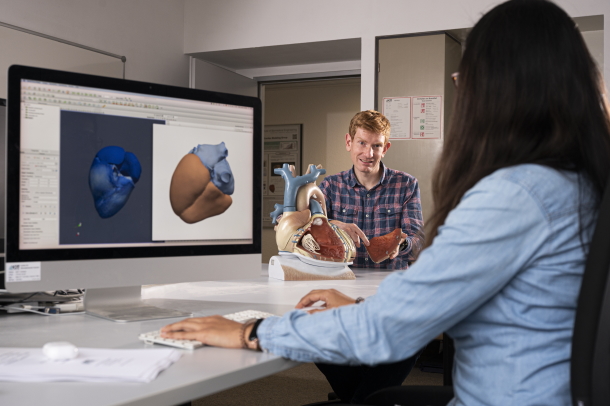
The aim of the working group was to realistically reproduce cardiac function in the computer model in order to be able to treat cardiac arrhythmias in a more targeted manner. In collaboration with the University Heart Center Freiburg-Bad Krozingen, the team retrospectively clinically validated the model-based findings. The results of the research show that not all patients benefit equally from the same treatment options. In the case of atrial fibrillation, the most common persistent cardiac arrhythmia, the central question is which small areas of tissue should be specifically scarred. "We built digital twin models using data from 29 patients and systematically compared 13 different treatment options. We were able to see that the accurate localization of connective tissue deposits in the atria is crucial for the success of personalized therapy," reports Loewe.
A prospective clinical study has now been running since fall 2024 to not only make a prediction, but also to treat directly in a targeted manner. "Together with Karlsruhe Municipal Hospital and Frankfurt University Hospital, we are using the computer model to make predictions for a patient group of around 60 people and then testing them directly in clinical practice. Compared to the last study, we no longer only have retrospective findings, but also make concrete predictions for each patient," Loewe continues.
In addition to prospective validation, the researchers are also working on further accelerating the calculation methods. On the one hand, through more targeted model simplifications in areas where no accuracy is lost but speed is gained. Secondly, through the use of machine learning and artificial intelligence.
Further links
Pictures: Markus Breig / KIT