TECHNOLOGY TRANSFER PROJECTS

As a rule, research results are still a large step away from a concrete product. For market relevance, further investments must be made in the development of the technology, the process, or the software.

To close the resulting financing gap, KIT has "TT projects". These are technology transfer projects that are carried out by an institute together with an industrial partner and in which KIT invests its own central funds.

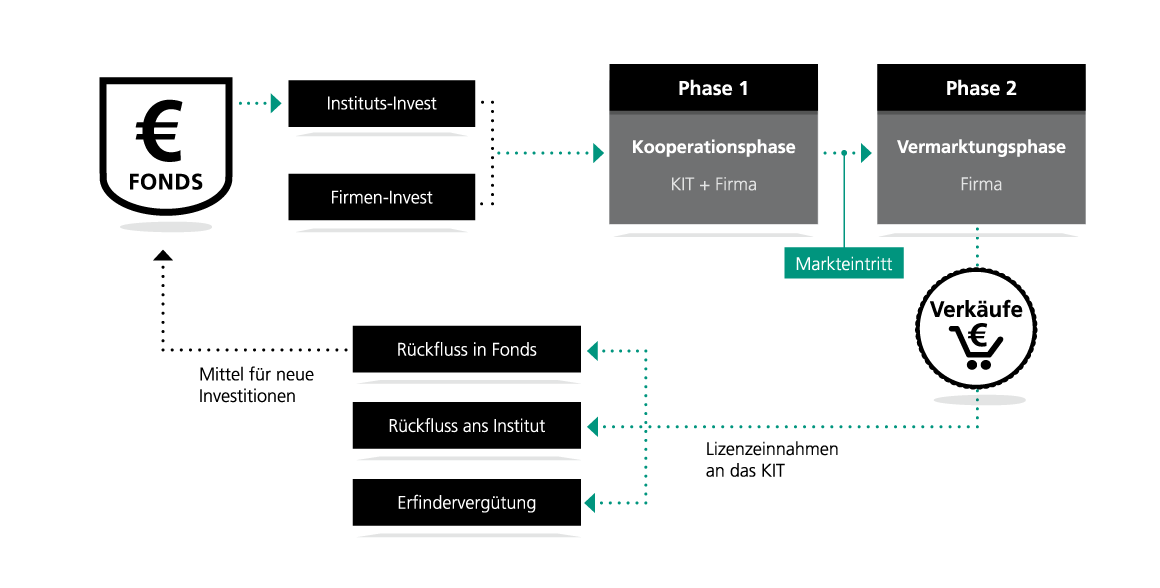
KIT and an industrial partner further develop an idea, research results, or technology until it becomes a marketable product or process. The financial expenditure is shared equally by the Innovation Fund and the partner. The product is then marketed by the industrial partner. The success on the market determines the returns to KIT, which are divided between the scientist, the institute, and the Innovation Fund.

Are you interested in a grant from the NEULAND - Innovation Fund? Then please contact our contact persons. They will check whether all requirements are met and support you in preparing the TT application. Information on the structure of the TT application can be found in our guidelines.

Contact person

The path to the technology transfer project

The Innovation Fund is not tied to a specific program or subject area, nor to a term, budget amount or call deadline. Individual funding is determined by the market potential of the product idea. The higher the later market potential and thus the expected return on investment (ROI) is estimated to be, the more can be invested in product development.

The only prerequisite for an investment from the fund is the willingness of an industrial partner to participate in the project both technically and financially by bearing the costs incurred by the partner itself. The entire project costs of the institute are pre-financed by the fund and are to be refinanced after the market launch by a participation in the later turnover (ROI) of the company. The higher the later market potential of the product idea and thus the expected ROI is estimated, the more can be invested in product development in advance.

You can submit an application for funding at any time. Application reviews for the Innovation Fund take place on an ongoing basis throughout the year by a steering committee.
Contact person

FUNDED PROJECTS

At KIT, new innovations, technologies or processes are constantly being developed. An important step for successful technology transfer is the cooperation with an industrial partner. In the following overview, we present a selection of successful TT projects of KIT.

MEASUREMENT OF ICE NUCLEI PARTICLES.

Institute: Institute for Meteorology and Climate Research (IMK-AAF)

Cooperation partner: Bilfinger Noell GmbH, University of Leeds

Start: 15.02.2018

Duration: 1 year 6 months

Ice core particles are the source of primary ice formation in clouds and often influence the formation and temporal and spatial distribution of precipitation. The goal of "PINE - Portable Ice Nucleation Experiment'" is to develop a modular and automated expansion chamber to measure these particles.

The functional principle of the PINE mobile expansion chamber is based on volume expansion, which is already known from the KIT aerosol chamber AIDA. In this process, the aerosol particles taken from the ambient air are activated inside the chamber to form mist droplets. Depending on the initial temperature of the chamber as well as the extracted air, a small part of the droplets freezes and forms larger ice crystals. Both the smaller droplets and the large ice crystals are measured with an optical particle counter to determine the concentration of ice nucleating particles (INPs) as well as the total particle concentration. PINE, unlike AIDA, is not limited to INP measurements and ice nucleation research and will function for chambers of variable size and different ranges of wall temperature and sampling pressure. This makes PINE the first instrument capable of automatically measuring long-term series of INP concentrations with high sensitivity, time resolution, and over a wide temperature range.

The Institute of Meteorology and Climate Research of KIT is working on this development together with the University of Leeds and Bilfinger Noell GmbH. Bilfinger brings a high level of competence in the field of refrigeration technology and was already intensively involved in the development of the new dynamic cloud chamber AIDA-2.

Further information: PDF Mobile Cloud Chamber PINE

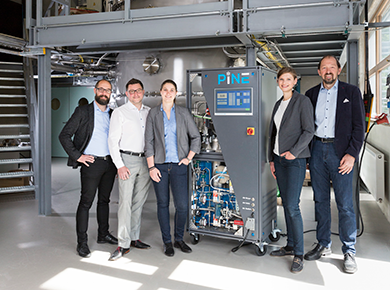
Image: The project team around PINE

MULTICENTER CLINICAL STUDY OF BREAST CANCER DIAGNOSIS.

Institute: Institute for Process Data Processing and Electronics (IPE)

Cooperation partner: Realcan Pharmaceutical Co, Ltd.

Start: 15.03.2018

Duration: 3 years 6 months

Together with Realcan Pharmaceutical, the IPE project team aims to develop the next generation of 3D ultrasound computed tomography (USCT) and validate the screening method for early breast cancer detection in a multi-center clinical trial in China and certify it for use in hospitals.

The availability of a cost-effective method for the early detection of breast cancer based on medical imaging techniques and thus a very early treatment option opens up the opportunity to significantly increase the survival rate of affected women. The Institute for Data Processing and Electronics (IPE) at KIT aims at developing an imaging 3D ultrasound tomography system (USCT) capable of detecting very small tumors with a diameter of up to 5 mm and enabling targeted biopsies.

Currently, the prototype 3D USCT II is being evaluated in close cooperation with the University Hospital Mannheim in a test series with approx. 200 test persons in order to verify the significance of the procedure in comparison to mammography and MRI. On the one hand, the cooperation with Realcan offers the opportunity to develop the next generation of the USCT system to market maturity. On the other hand, direct contacts to a large number of clinics via the distribution network of the Chinese pharmaceutical company can support the validation and recognition of the USCT screening method. It is planned to examine more than a thousand test subjects in parallel in several clinics in a multi-center clinical study and to use the data sets both for validation and for general acceptance and establishment of the screening method in medicine.

The USCT method is already considered an innovative alternative to mammography. It enables an early and thus better diagnosis of breast cancer without the radiation risk associated with mammography.

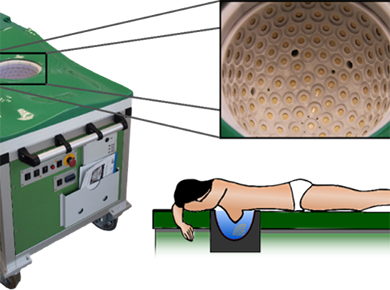
Image: Functional principle of the 3D ultrasound tomography system.


PHOTONIC MARKERS

Institute: Institute for Microstructure Technology (IMT)

Cooperation partner: Polysecure GmbH

Start: 01.05.2015

Duration: 3 years

In the context of the technology transfer project "ParMESaN" (Photonic Markers for anti-counterfeiting solutions and plastic sorting), KIT is working together with Polysecure on new ways to separate different plastics by type and to identify counterfeit products by means of fluorescent markers.

Since in the case of complaints or damage claims, brand manufacturers often have the difficult task of proving that the product is a counterfeit and not their original, they incur considerable costs due to product piracy. In the TT project "ParMESan", the KIT team and its industrial partner Polysecure are trying to apply a kind of fingerprint identification to the product by doping it with fluorescent markers, which is invisible to the naked eye. Only when the developed markers are irradiated (excited), for example with laser light of a specific wavelength, is a glow in fluorescent colors achieved through upconversion fluorescence. Depending on the materials used, this can glow from red through yellow and green to blue. The resulting pattern can be flawlessly identified in a tamper-proof manner and used as a viable and economical solution to ubiquitous product piracy.

Fluorescent markers can also be used to great effect in the plastics recycling sector. On the one hand, to sort materials that are very similar and cannot be easily differentiated by other methods - for example, fiber-reinforced plastics that need to be separated from identical, pure plastics. On the other hand, the fingerprint can also be used to separate a large number of plastics from each other in terms of shape and color so that they can be specifically reused - e.g. food packaging (drinking bottles) is returned to the beverage industry. This would be a great contribution to the circular economy concept. The task and competence of KIT in this project is to identify and develop new materials, optimize their quantum yield, and contribute to their industrial production.

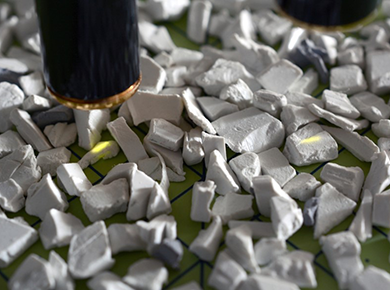
Image: Plastic identification by means of optical detection

KALIBIO

Institute: Institute for Technical Chemistry (ITC)

Cooperation partner: VITROCELL Systems GmbH, Waldkirch

Start: 2012

Duration: 3 years

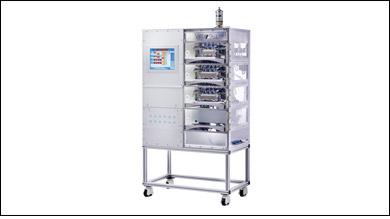
In cooperation with VITROCELL Systems GmbH, the project team is developing an automated system for the exposure of lung cells to ultrafine aerosols.

In Air-Liquid-Interface (ALI) exposure, cell cultures are exposed to gases or aerosols and their biological effects are subsequently investigated. The ALI technique has distinct advantages because the lung cells are treated under physiological conditions and the low particle dose is measured.

In the KALIBIO project, an automated measuring device for ALI exposure of bioassays was developed and introduced to the market. Based on campaign experience, safe-by-design solutions for operation and experiments were developed and implemented. The exposure system is now used by research institutes in Munich, Rostock, Oslo (Norway) and Bilthoven (Netherlands) to assess the toxicity of nanoparticles from industry and combustion.

Further information: PDF Vitrocell

Publications:

AEROBUSTER

Institutes: Institute of Nanotechnology (INT), Institute for Data Processing and Electronics (IPE), Institute of Fluid Mechanics (ISTM), Institute for Thermal Energy Technology and Safety (ITES), Institute of Meteorology and Climate Research (IMK) und Institute of Functional Interfaces (IFG)

Start: 2020

Duration: 3 years

An interdisciplinary research team at KIT wanted to curb the spread of coronavirus and other viral diseases with a cost-effective and versatile air steriliser.

The air purification system they developed uses heat and UV light to inactivate virus- and bacteria-laden aerosols in indoor spaces such as classrooms, medical practices and restaurants. From the initial idea in spring 2020, several prototypes of the virus inactivator
were built and validated in a very short time. To validate the Aerobuster, contact was also sought with well-known/leading virologists. They confirmed the project, but external factors ultimately prevented it from succeeding in the market.

Further information: PDF Aerobuster

Earthquake wallpaper

Start: 2010

Duration: 7 years

Every year, earthquakes cause severe damage to buildings and cost human lives. Older masonry buildings without adequate earthquake protection are particularly at risk.

Millions of existing buildings lack adequate earthquake protection, over 70 percent just in Germany. Conventional retrofitting is often expensive and invasive. Researchers at
KIT have teamed up with a manufacturer of technical fabrics to develop a textile reinforcement made of high-performance fibres that can be used as a building envelope to prevent wall failure by distributing forces evenly. In the event of vibrations, it holds the building together and prevents collapse – quickly, invisibly and cost-effectively. The system is being marketed worldwide through the industrial partner.

Further information: PDF earthquake wallpaper

DriveSim – Virtual driving instructor for megacities

Institutes: Institute for Information Management in Engineering (IMI)

Start: 2014

Duration: 5 years

The DriveSim project used advanced technologies such as virtual reality, artificial intelligence, eye tracking and web-based map services to create a realistic and interactive driving simulation experience for driver training.

A real mid-range car was converted into a driving simulator using the network interfaces already present in the vehicle, the steering wheel and other controls could be used just like in real driving situations. Force feedback technology and VR projections allowed the driver to experience their driving behaviour, road conditions and surroundings in real time. An integrated tutor system analysed driving behaviour, provided feedback and supported the individual learning process.

Further information: PDF DriveSim

Iced coffee at the touch of a button

Institutes: Institute for Micro Process Engineering (IMVT)

Start: 2007

Duration: 3 years

Iced coffee is usually prepared sequentially, first by brewing the coffee and then cooling it. However, this manual process can result in a loss of aroma.

KIT collaborated with a vending machine manufacturer to investigate how iced coffee could be dispensed directly from a machine without any loss of aroma. With the help of a micro-process cooling
unit from KIT, the coffee was cooled immediately as it flowed through, significantly reducing the loss of aroma. The production of delicious, aromatic cold coffee works excellently under laboratory conditions. For technical reasons, the machine did not reach market maturity, as the compressor required for heat dissipation was not available in a smaller version and no further development partner could be found.

Further information: PDF Iced coffee at the touch of a button

Energy-efficient luminaires with mid-power LEDs

Institutes: Light Technology Institute (LTI)

Start: 2018

Duration: 3 years

The switch from energy-intensive street lighting to LED technology has not yet been completed in all municipalities and cities.

Robust, lowmaintenance systems are particularly important in public spaces. A special circuit topology developed by KIT promised significantly more economical, fail-safe and durable LED lights. The reliability of these lights is increased because if one or more LEDs are destroyed, the entire module does not fail immediately. After the development of a prototype, a test field with the new LED street lights was opened in the municipality of Maxdorf. Despite the innovation potential, market success failed to materialise because many municipalities continued to rely on existing, still functional lights or cheaper LEDs for financial reasons.

Further information: PDF Energy-efficient

Grapes under high tension

Institutes: Institute for Pulsed Power and Microwave Technology (IHM)

Start: 2000

Duration: 5 years

Mashing and mash heating are established methods of red wine production.

Both processes aim to extract colour and tannins from the grape skins. An alternative method developed by KIT for breaking down grape mash has led to improved extraction of these substances: electroporation, i.e. the targeted opening of biological cell membranes using pulsed electric fields. This technique has made it possible to extract substances from the grape skins gently and efficiently. In addition to improved extraction for a distinctive red wine character, heating and, in the case of white wine, enzyme treatments and long maceration times were no longer necessary. The breakdown of the grapes was successfully demonstrated, but unfortunately failed at the time due to scepticism on the part of the winegrowers.

Further information: PDF Grapes

Spring systems made of fibre-reinforced plastic composites

Institutes: Institute of Vehicle Systems Technology (FAST)

Start: 2014

Springs are used when components need to bear loads and remain elastic.

In high-performance applications, conventional steel springs reach their limits due to their weight. Fiber composite springs, made from carbon or glass fiber reinforced plastic (CFRP, GFRP), offer a lighter and more powerful alternative. Researchers at KIT have developed more powerful XFK springs that achieve optimum utilisation of the fibres across the load cross-section. X stands for the fibre variable, where the fibre type, fibre concentration and orientation within the composite can be varied to make optimum use of the material properties. This enabled more even stress distribution and more efficient load-bearing capacity of the spring. The new springs were manufactured and tested for use in sectional doors in collaboration with a company from the steel spring industry.

Further information: PDF Spring systems

Battery management for photovoltaic home storage systems

Institutes: Institute for Data Processing and Electronics (IPE)

Start: 2016 

Duration:  4 years

In times of energy transition, electricity is no longer generated and supplied solely by energy companies and utility providers.

Photovoltaic has laid the foundation for everyone to produce their own renewable energy using solar cells. To store this electricity safely at home, researchers at KIT have teamed up with RCT Power GmbH to develop a battery management system (BMS) for stationary home storage systems. In the transfer project, a proven BMS from KIT was adapted in a way that it can be used and operated economically in stationary home storage systems. Thanks to the experience from KIT in the field of mobile lithium-ion storage, a reliable system was realised in a short period of time.

Further information: PDF Battery management

Magnetic separation for RNA purification

Institutes: Institute of Functional Interfaces (IFG)

Start: 2000 years

During the COVID-19 pandemic, PCR tests were crucial for detecting SARS-CoV-2.

Isolating viral RNA from patients‘ throat and nose swabs played a key role in laboratory analysis. A KIT technology for handling magnetic microparticles provided the solution to efficiently, automatically and reliably extract RNA from samples. The technology has since been used extensively in commercial laboratory systems from PerkinElmer chemagen Technologie GmbH.

Further information: PDF Magnetic psearation

Flue gas cleaning in incineration plants

Institutes: Institute for Technical Chemistry (ITC)

Start: 2006 years

Ordinary household waste contains chlorine, which forms dioxins when burned.

In addition to the toxic emissions produced, these also cause boiler corrosion in incinerators. Several methods have been developed at KIT to reduce the combustion process and pollutant formation. In addition to intensive monitoring and control of the burnout in the combustion chamber, the researchers developed special plastic fillers made of polypropylene (PP) that absorb the dioxins from the flue gas. In combination with fine carbon particles, the fillers have a strong bond and are not released again even when temperatures fluctuate. The process is marketed by Götaverken Miljö AB and is being used successfully in several plants.

Further information: PDF Flue gas cleaning

Inspection robots for pipelines and pipes

Institutes: Institute for Data Processing and Electronics (IPE)

Pipelines and pipes are a central pillar of infrastructure in our modern society.

They are used to transport oil, gas and numerous other substances over long distances, thereby making a significant contribution to energy supply and economic progress. Non-destructive testing of
these pipes is extremely important in order to detect safety-relevant damage such as corrosion or cracks at an early stage. A method developed at KIT for this purpose is ultrasonic testing, which enables precise assessment of the condition. These autonomous systems, which are pumped through the pipeline with that oil or gas, use magnetic and ultrasonic sensors to detect defects in the form of corrosion and cracks in real time. The system is distributed worldwide through an industrial partner.

Further information: PDF Inspection robots

Contact person

Diese Seite nutzt Website-Tracking-Technologien von Dritten, um ihre Dienste anzubieten. Ich bin damit einverstanden und kann meine Einwilligung jederzeit mit Wirkung für die Zukunft widerrufen oder ändern.

Alle akzeptieren Einstellungen Nur notwendige akzeptierenImpressumDatenschutz