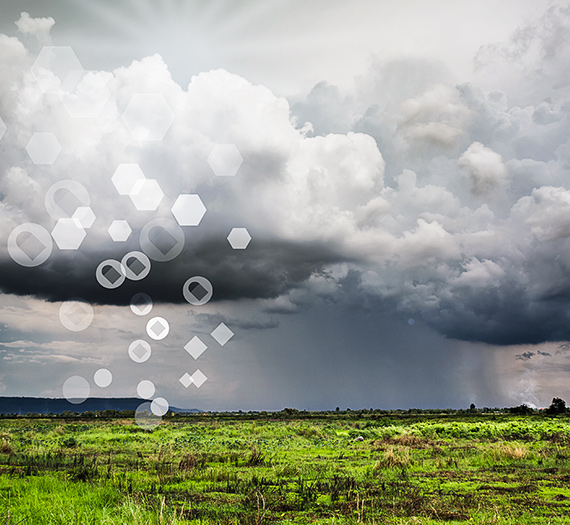
How an Artificial Intelligence listens to the soft murmur of water and provides an early warning before it turns into a roaring flood.
Small rivers are often seen as modest idylls: Lush green along their banks, the gentle babble of water exuding calm, and a leisurely walk offers the chance to spot a variety of wildlife that calls the stream home. But these seemingly harmless waterways are one of the hidden hazards of our time. Sometimes all it takes is a rise in water level after a summer thunderstorm or a stray cloudburst hitting a valley basin. Small streams in particular react incredibly fast to heavy rain and can turn into raging torrents within minutes or a few hours. These fastreacting catchments are characterized by short lead times, high uncertainties and a huge damage potential.
The project collects water level flow and precipitation data in real time and integrates it into AI models. The aim is to use this data to develop reliable warning signals before small rivers become major hazards.
Giving the Whisper a Voice
The KI-HopE-De research project aims to understand that whisper of the rivers and give it a voice that can warn in time. „We are researching and developing modern methods of artificial intelligence for use in river basins smaller than 500 km² throughout Germany. This approach enables us to potentially build a uniform forecast for all of Germany and thus improve the prediction of extreme weather events,“ says Dr. Ralf Loritz, junior research group leader of the „Energy and information flows in hydrological systems“ group at the Institute for Water and Environment (IWU) at KIT. His motivation? The PhD-trained hydrologist, cites curiosity as his driving force: „With the increasing use of AI, my fascination with how these models work has grown. This, in turn, has led to a pragmatic attitude: What adds value in other areas could also provide valuable support in hydrology. I then pursued this as a post‑doc and later with my early‑career team, and the results confirmed my hunch. My research has shown that these models are very good at mapping hydrological conditions and rivers.“
How KI-Hope-DE works
Small rivers are like sleeping giants: Harmless in everyday life, but overwhelming during heavy rainfall. Water levels rise rapidly, often catching residents and emergency services off guard. Climate change and growing frequency of extreme weather events will amplify this risk in the future. Lead times are becoming drastically shorter, pushing current models to their limits. KI-HopE-De gathers and inte grates hydrological data from all over Germany, trains AI models and enables early warnings to protect communities from disaster in time.
Using AI to Combat Disaster
What began as scientific curiosity is now becoming a tangible project with KI-HopE-De. Together with fellow KIT researchers from the Institute for Meteorology and Climate Research (Prof. Dr. Peter Knippertz), the German Weather Service and various state agencies, Loritz and his colleague Dr. Uwe Ehret from IWU want to fight potential catastrophes with AI. The project’s name reflects its ambition to achieve what conventional models cannot deliver in small river basins. Loritz explains: „Traditional, physics-based models are used for large rivers. These models calculate water levels and discharge and are very accurate. However, they are complex to set up, often optimized for a single catchment or river, and heavily dependent on reliable precipitation forecasts. Where meteorology becomes imprecise, such as in locally limited thunderstorms, they reach their limits.“ A classic model calculates a fixed amount of rainfall. This is exactly where KI-HopE-De steps in. Machine-learning models trained across many rivers learn patterns from historical water level and precipitation data, allowing them to statistically incorporate the uncertainty of multiple weather scenarios. Even uncertain forecasts, such as wide ranges of expected rainfall, can be turned into useful runoff predictions. The result is an AI-driven flood-forecasting system that can provide crucial guidance when lead times are short. „The models learn directly from national scale hydro-meteorological dataset allowing them to cope with the amount of work involved, to deal with uncertainties more effectively and to enable forecasts for areas spanning multiple states,“ reports Loritz.
The KI-HopE-DE research team at KIT: Together with the german weather service and several state agencies, the group led by Dr. Ralf Loritz (third from left) and Uwe Ehret (right from Ralf Loritz) is developing AI models designed to improve flood forecasting in small catchment areas.
The Data Lake as a Foundation
One of the goals is hence the creation of a single, nationwide dataset. Water-level records, runoff, precipitation, temperature, wind speed, land-use – all stored in one database. So far, these measurement series in Germany are often fragmented: State agencies, associations, subgroups or regional councils each manage their own data. For researchers, this has resulted in numerous data-request negotiations, incompatible formats and often limited access. Loritz emphasizes: „No one really knows what measurements we carry out in Germany in the field of environment and water. The creation of a hydro-meteorological uniform data set for Germany is therefore an important milestone. Through the cooperation of partners from research, industry and the public sector, we can collect a large amount of data for better research. Even if the project does not receive follow-up funding in the end, we would still have this important treasure trove of data. For research, for future projects and for better risk assessment.“
From Lab to Control Room
However, KI-HopE-De is not purely a showcase research project: Initial data sets and simple models for North Rhine-Westphalia, Rhineland-Palatinate and Baden-Württemberg already exist and have been handed over for implementation to flood-forecasting centers. To ensure the algorithms can be used smoothly and transferred from theory to practice, researchers are training staff from the state agencies in workshops. Implementation requires care: Server failures or delayed weather data are real risks when AI is embedded into operational forecasting chains. „A lot can be demonstrated in the laboratory – the question is how these results can be confirmed in practice, where nothing can go wrong because property damage or, in the worst case, human lives are at stake,“ says Loritz, looking toward the first test phases. This is a question that the project aims to answer within the remaining two‑year timeframe. The whisper of the rivers remains – but now it is audible: KI-HopE-De creates a voice that turns fragmented data into a coherent whole.
The project collects water level, flow and precipitation data in real time and integrates it into AI models.
The project team behind KI-HopE-DE.
The project collects water level, flow and precipitation data in real time and integrates it into AI models. The aim is to use this data to develop reliable warning signals before small rivers become major hazards.
Keyfacts:
GOAL
Development of an AI-driven flood-forecasting system to improve weather prediction, run-off modeling and early warnings for extreme weather events
APPLICATION
Implementation in German flood-forecasting centers with special focus on small river catchments
PROJECT PARTNER
Karlsruhe Institute of Technology (KIT); German Weather Service (DWD); State Office for Nature, Climate and Environment North Rhine-Westphalia; State Office for the Environment Rhineland-Palatinate
Diese Seite nutzt Website-Tracking-Technologien von Dritten, um ihre Dienste anzubieten. Ich bin damit einverstanden und kann meine Einwilligung jederzeit mit Wirkung für die Zukunft widerrufen oder ändern.