- Information
- Mobility
WHAT BECAME OF… „LOGIKTRAM“

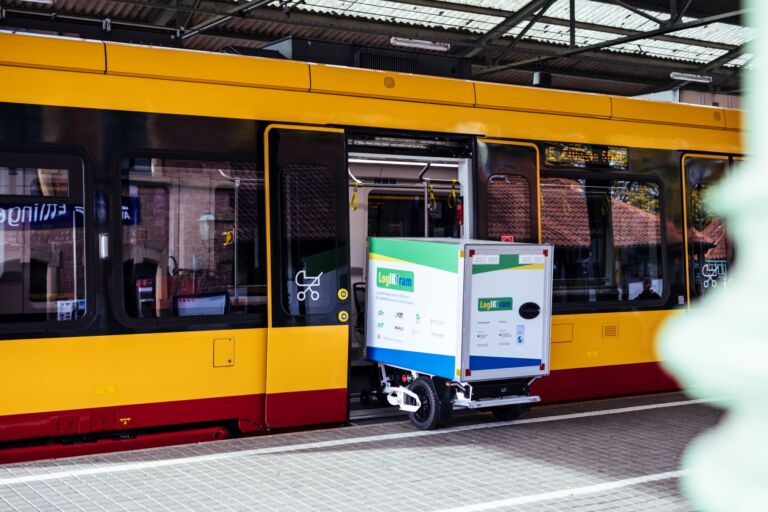
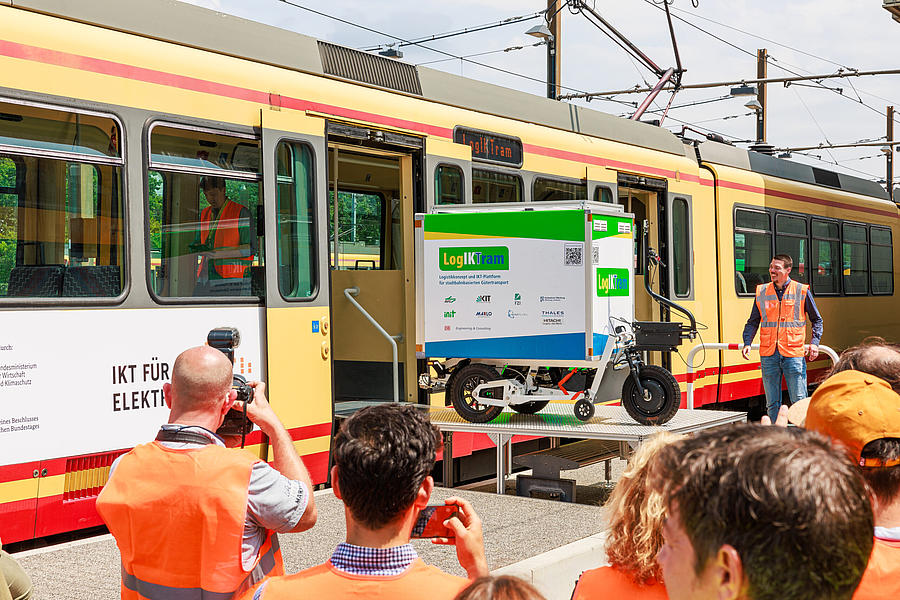
LogiKTram has become regioKArgoTramTrain. However, the goal remains the same: to develop innovative solutions that harness unused capacity in public transit for freight transport. The idea is simple: underutilized trams, which are already traveling through the city, transport packages alongside passengers in a special cargo trailer (eTrailer). The eTrailer moves autonomously at stops and boards and disembarks on its own. However, the complex system involving the tram, traffic control, the trailer and passengers presented a significant challenge. For the project partners, it was important not only to ensure technical feasibility but also to assess the expected impact on road and rail traffic.
Through an internal pilot study conducted at the Albtal-Verkehrs-Gesellschaft (AVG) West Depot, the regioKArgoTramTrain team has reached an important milestone in exploring the system’s interactions. Together with project partner INIT Group, realistic passenger scenarios were simulated to collect initial data from the rail system’s multifunctional area. This designated area is intended for the combined transport of passengers and goods. During the testing, participants took on the roles of various passenger groups and used items such as wheelchairs, walkers, bicycles and luggage. The eTrailer had to navigate around these “obstacles” during the live test. The camera data collected by the railway forms the basis for an AI application that will, in the future, detect in real time whether the multifunctional area is occupied or free. This will ensure that the loading units developed in the project are used only when there is sufficient space remaining for regular passenger service.
With this study, the team has taken another step toward the intelligent and demand-driven use of existing transportation resources - and continues to work on “filling emptiness with meaning.”
Further Links:
Images:
- wong nerimo, malerapaso / iStock.com
- Amadeus Bramsiepe / KIT
- Paul Gärtner / AVG